
A home-repair company goes digital, part 1: why build a service-scope and quote entry first, not a dispatch system or an app
A home-repair company living off neighborhood repeat business, with technicians in the field and quotes depending on on-site judgment, hurts less from lacking a dispatch system than from vague customer problems it can't even see in its own books. Phase one builds an entry and a record so vague problems become traceable leads.
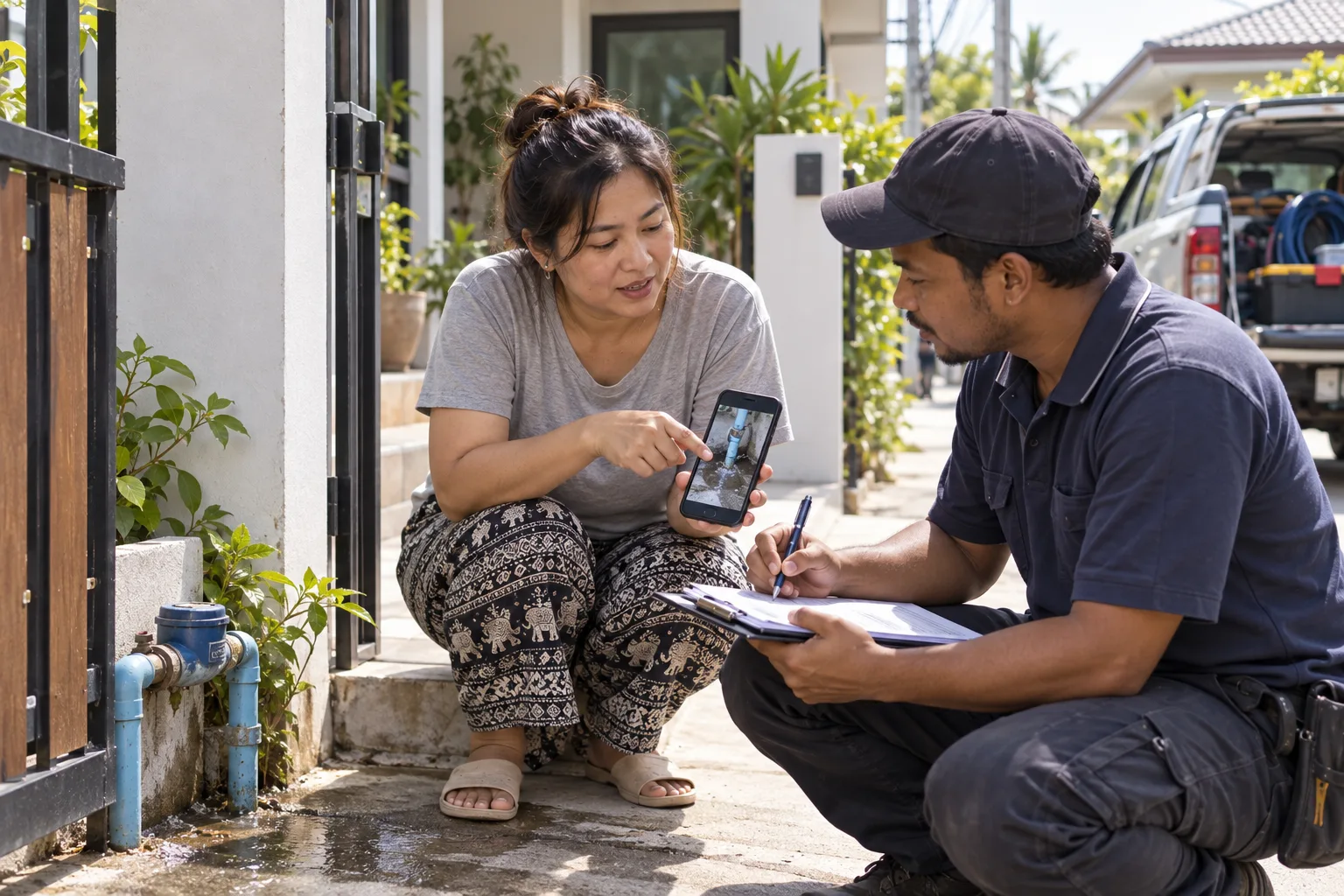
This series follows a home-repair company in Chonburi, step by step, into digital. The story comes from our real implementation experience in the home-services industry — if you run a small service company living off repeat customers, you should see your own vans in every chapter. Each chapter explains: what was built, what was deliberately not built, and what evidence earned the right to move on.
The company as it was
This is a home-repair company in Chonburi, serving a concentrated area — basically one neighborhood. Seven technicians are split into teams by specialty: plumbing and electrical, air-conditioner service, appliances, and leaks and waterproofing. Technicians go on site, quote on the spot, and do the job; business is built one order at a time from the same neighborhood coming back.
The owner knew best three things were quietly eating the company:
- Customer problems are vague. Most calls are “the tap is leaking”, “the AC isn’t cold”, “water is seeping upstairs”. What is actually wrong, what needs replacing, and how much it costs all take a technician on site to find out. And some jobs don’t need a visit at all — a phone or video call could sort them out — but with no standard, technicians often make wasted trips.
- The company can’t see which work actually makes money. Quotes depend on what the technician says on the spot; completed jobs live on paper and in memory. Ask the owner “last month, how many jobs were plumbing, AC, leaks, which made money, where did the technicians’ hours go?” — he could only guess.
- Repeat customers rely on the customer remembering. The next time a customer’s home has a problem, whether they come back depends on whether they saved the phone number or have the LINE chat. There is no systematic “repeat-customer entry point”, and the neighborhood customer pool is only so big — repeat customers are the lifeline.
But the owner also knew that what he needed most was not a dispatch system, and not an app. It was: when a customer has a problem and doesn’t know how to describe it, give them one simple entry to explain the situation and leave contact details; and let the company see, for the first time, what business it is actually in.
What phase one actually built
The first website did four things only:
- Service-scope page — what the company does: plumbing, AC, appliances, leaks; how each is priced; what counts as a major job. The words technicians and staff repeated on the phone became one reference written once and valid for a long time.
- Quote-logic page — explains why on-site repair needs a site visit before a price, and what can be judged over the phone first, so customers stop asking “why do you still need to come out?”
- Quote-request entry — one simple form: what’s the problem, roughly when is convenient, where is the home, how to reach you. The clearer the customer describes, the more prepared the technician, the fewer wasted trips.
- Contact page — phone and LINE in the most visible spot, every page pointing to the same action: describe the problem, leave contact details, wait for a quote.
The website’s job was to turn vague problems into traceable leads, not to replace how technicians do the work on site. There was no dispatch system in phase one — taking orders, assigning jobs, going on site, quoting, and doing the work all stayed as they were.
What this phase was deliberately not
This is where most home-service owners get their first project wrong, so it deserves its own list. Phase one had no:
- No dispatch scheduling system. No route board, no auto-dispatch, no technician tracking. Seven technicians’ work is still handled by staff coordination and the team’s own rhythm — not worth a system yet.
- No native app. No app-store listing, no download, no accounts. The repeat-customer entry point is a phase-two PWA discussion — it costs far less than an app and is enough.
- No customer-relationship system (CRM). No customer profiles, no membership, no automated marketing.
- No online payment. Quotes, completed jobs, and collection keep going through existing channels: cash, transfers, or face to face.
“Not yet” is not a shrunken goal. It is not claiming the company doesn’t need dispatch or repeat-customer tools — it is making this phase small enough to finish, asking the technicians to change only a little, and letting real data rather than guesses decide the next step.
What entering phase two requires
The company had a longer roadmap all along: see its business composition, cut wasted trips, turn repeat customers into an asset that keeps coming back. Before approving the next phase of building, it agreed to watch two things:
- whether, with a unified quote-request entry, customers describe problems more clearly and wasted trips really drop;
- whether those requests can be recorded in one place, so the owner sees for the first time which jobs are worth the trip and which lose money.
Part 2 is about how phase one landed: a quote-request form plus phone/LINE guidance, and how quote requests became one trackable record.
Boundary matters: the service-scope and quote-info website, the quote-request form, and phone/LINE guidance are a normal website project. The PWA repeat-customer entry, dispatch scheduling, online payment, customer accounts, and CRM in this series are separate projects with their own scope — they are not part of a standard website package, and phase-two PWA especially is not.